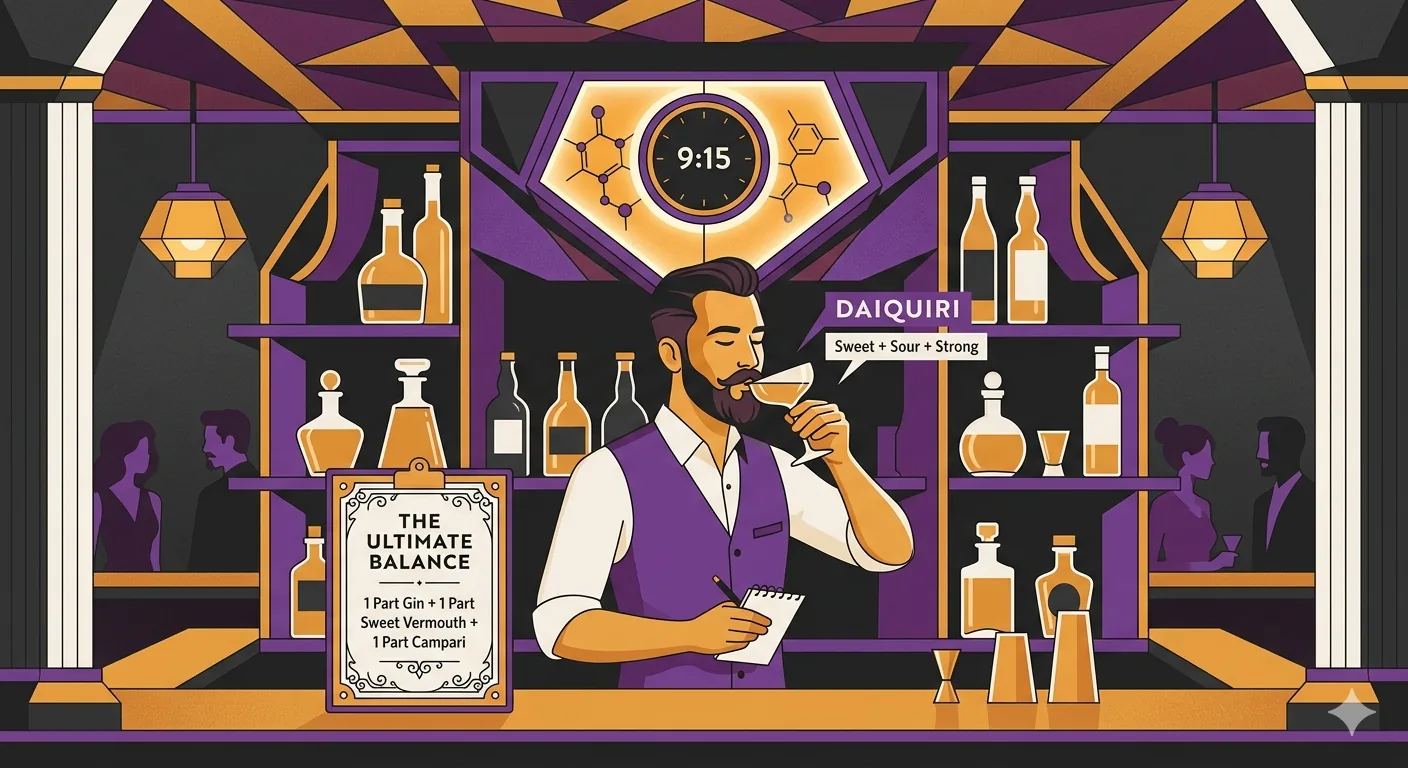
I’ll never forget the night a regular came in, slumped onto a stool, and begged me for "something strong, something sweet, but also kinda sour... just make it work." He’d had a brutal day, and his brain wanted a flavor profile that was doing absolutely everything all at once.
It's a request bartenders hear all the time, and if you aren't careful, trying to hit all three notes results in a chaotic, throat-burning soup.
But making those three elements play nice isn't a guessing game. It is a balancing act as old as mixology itself. Once you understand how sweet, sour, and strong interact, you can manipulate any bottle on your shelf to create a drink that hits the palate with seamless perfection. Let's look at how we pull off the ultimate liquid tightrope walk.
The Triangle of Flavor: Sweet, Sour, and Strong
Every great cocktail relies on a delicate power dynamic. Think of your base spirit (the strong) as the canvas, while your citrus (the sour) and your syrup or liqueur (the sweet) are the paint.
If you have too much strong, the drink burns and puts hair on your chest in all the wrong ways. Too much sour, and your face turns inside out. Too much sweet, and the drink feels heavy, cloying, and altogether un-refreshing.
The secret is that sweet and sour are natural antagonists; they mask each other's extremes. A shot of straight lime juice is agonizingly sharp. A shot of straight sugar syrup is sickeningly sweet. But combine them in equal measures, and they transform into a bright, vibrant nectar that perfectly tames the fiery punch of a high-proof spirit.
The Equal Parts Masterclass: The Bitter Counterweight
While sours lean heavily on citrus, you can achieve a totally different kind of balance by introducing bitterness into the sweet-and-strong equation. Look no further than the iconic Negroni for the ultimate proof.
The resulting equal parts build - gin, sweet vermouth, and Campari - is a masterclass in flavor profiling. The sharp botanicals of the gin provide a heavy, strong structural backbone. Then, the rich, dark-fruit sweetness of the vermouth coats the tongue. Finally, the intense, herbal bitterness of the Campari cuts right through that sweetness.
The bitterness of the Campari doesn't fight the sweet vermouth; it plays with it, creating a complex, bittersweet loop where the strong base spirit is perfectly cushioned by both sides.
The Master Class: Why Dilution is the Final Pivot
You can measure your ingredients down to the exact drop, but your sweet, sour, and strong balance will fall completely flat without the most important technical tip in the industry: Dilution is an active ingredient, not an accident.
When you mix a drink with ice, the melting water isn't just chilling the liquid - it is physically altering the chemistry of the glass. Water breaks down the tight alcohol bonds of the strong base spirit, lowering the proof just enough to let the volatile aromatic compounds of the sweet and sour components escape into the air.
When to Shake: For drinks balancing sweet, sour, and strong using fresh citrus (like a Daiquiri or a Whiskey Sour), you must shake vigorously. The violent agitation forces air into the liquid, fracturing the ice to rapidly dilute the drink while creating a frothy, aerated texture that softens the citrus bite.
When to Stir: For all-alcohol, spirit-forward balanced drinks (like a Negroni), you stir smoothly. This preserves a velvety, crystal-clear texture that lets the heavy sweet and bitter elements glide across your palate with luxurious weight.
Try This Tonight: The Balanced Daiquiri
Forget the blended, neon-colored sugar bombs you get at tourist resorts. A true, classic Daiquiri is the ultimate, pristine test of a bartender’s ability to balance sweet, sour, and strong.
Ingredients
- 2 oz (60ml) Good Quality White Rum (The Strong)
- 1 oz (30ml) Freshly Squeezed Lime Juice (The Sour)
- 0.75 oz (22.5ml) Simple Syrup (1:1 sugar and water) (The Sweet)
Method
- Pour the lime juice and simple syrup into your shaker tin first (always build your cheap ingredients first, just in case you mess up the measurement).
- Add your white rum.
- Fill the shaker to the absolute brim with solid, hard ice cubes.
- Shake like you mean it for 10 to 12 seconds until the outside of the tin is frost-bitten and freezing.
- Double strain into a chilled coupe glass.
Take a sip. You should taste the crisp punch of the rum, followed instantly by the bright, tongue-snapping zest of the lime, finished by a clean, smooth sweetness that wipes the palate clean for the next sip.
Once you learn to control the sweet, the sour, and the strong, you don't just follow recipes - you command them. Have fun playing with the variables tonight, look after your guests, and I'll see you for the next round.