If you have ever tried to look suave while shaking up a batch of Friday night drinks, only to have the top cap of your shaker fly off and coat your ceiling in sticky passionfruit syrup, welcome to the club.
We have all paid our dues to the cocktail gods that way.
When you decide to move past pouring basic two-ingredient highballs and start mixing proper cocktails at home, you run face-first into the great hardware debate: the Boston shaker versus the Cobbler shaker. Walk into any high-end cocktail den, and you’ll see bartenders wielding two massive metal tins with lightning speed. Go to a boutique home goods store, and you’ll find elegant, three-piece glass and gold contraptions.
So, which one actually belongs on your counter? Let’s break down the heavyweight matchup of the bar world.
The Elegant Trio: The Cobbler Shaker
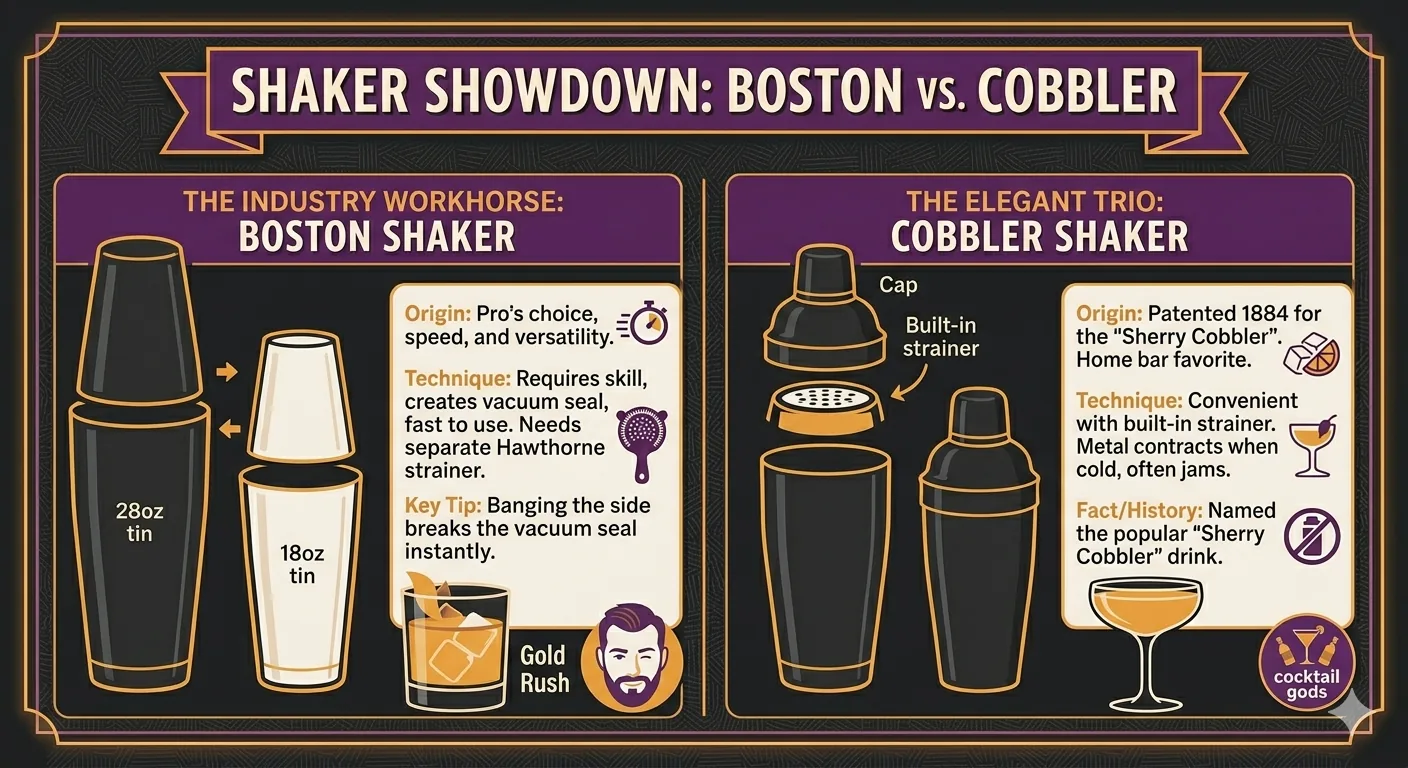
The Cobbler is the three-piece shaker you see in classic movies. It features a large base tin, a mid-section with a built-in perforated strainer, and a small cap that sits over the spout. It looks sophisticated, feels substantial in the hand, and appears incredibly convenient because you don’t need to buy a separate strainer.
A Quick Bit of History: The Cobbler shaker wasn’t actually invented for the modern cocktail bar; it was patented in 1884 by Edward Hauck to make the wildly popular "Sherry Cobbler"
The drawback? Physics is a cruel mistress. When metal gets freezing cold, it contracts. That built-in strainer and top cap love to seize up mid-shift. You will find yourself frantically running the cap under hot water or banging it against the edge of the counter just to pour your next drink. Furthermore, those tiny built-in holes restrict liquid flow, turning a crisp pour into a sluggish drizzle.
The Industry Workhorse: The Boston Shaker
The Boston shaker is the undisputed king of the professional backbar. It consists of two simple pieces: a large tin (usually 28 ounces) and a smaller mixing tin or glass (around 18 ounces). You dump your ingredients into the small tin, slap the large one over the top at an angle, give it a firm tap to create a vacuum seal, and start rattling.
It is fast, it never jams permanently because a quick thump to the side breaks the seal instantly, and it is incredibly easy to clean.
The only catch is that it requires a tiny bit of technique. It doesn’t have a built-in strainer, meaning you have to pair it with a separate Hawthorne strainer to keep the ice chunks out of your glass. It can also feel intimidatingly large if you have smaller hands, but once you get the muscle memory down, you’ll never want to go back.
The Master Class: The Chemistry of the Shake
No matter which tool you choose, the end goal is the same. And that brings us to the ultimate technical tip of the evening: Shaking isn’t just about making a drink cold - it’s about changing its structural DNA.
As we’ve talked about before behind this counter, cocktails that are purely spirit-forward (like the timeless equal-parts Negroni, where the bitterness of Campari plays beautifully with the sweet vermouth) should always be stirred to protect their silky, crystal-clear texture.
But when you introduce citrus juice, egg whites, or cream, you need the violent agitation of a shake.
Shaking violently forces air into the liquid, fracturing the ice into micro-crystals and creating thousands of microscopic air bubbles. This process aerates the drink, completely transforming the flavor profile by softening sharp acids and emulsifying sugars. It yields a light, effervescent texture and a beautiful, frothy head that you simply cannot achieve with a bar spoon.
Try This Tonight: The Ultimate Texture Test
To see why the Boston shaker wins the speed and texture battle for drinks with heavy citrus, let's mix up a classic Gold Rush. It is a rich, velvety variation of a whiskey sour that perfectly showcases the power of a hard shake.
Ingredients
- 2 oz (60ml) Bourbon Whiskey
- 0.75 oz (22.5ml) Fresh Lemon Juice
- 0.75 oz (22.5ml) Honey Syrup (Equal parts honey and warm water dissolved)
Method
- Combine all ingredients in your shaker tin. If using a Boston shaker, build it in the smaller tin first.
- Fill the tin to the brim with solid, hard ice cubes.
- Seal your shaker tightly and shake with absolute enthusiasm for a full 10 to 12 seconds. You want to hear the ice smashing hard against both ends of the tin.
- Strain into a rocks glass over one large, fresh ice cube.
Take a look at the top of that drink. If you shook it hard enough, you’ll see a gorgeous, micro-foam layer of tiny bubbles floating on top that makes the first sip incredibly soft and luxurious.
If you are just starting out and want something beautiful for a bar cart that handles one or two drinks a night, a high-quality Cobbler will treat you fine - just don’t freeze the cap shut. But if you want to mix with speed, ease, and zero sticky cleanups, do yourself a favor and pick up a set of metal-on-metal Boston tins.
Grab your shaker of choice, work on that technique, and I’ll have the ice ready for you next time. Cheers.