There's a particular silence that falls over a bar when someone orders a Margarita and then adds, "but, you know, a good one." I always smile, because what they're really telling me is that somewhere along the line they were served a slushie of neon mix and regret, and they've never quite recovered. The good news is that the Margarita isn't a hard drink. It's an honest one. And almost everything people argue about - the salt, the sweetness, whether it should ever meet a blender - comes down to a little chemistry we can sort out right here over the counter.
Nobody Knows Who Made It (And That's the Fun Part)
The Margarita has more origin stories than it has ingredients. Depending on who's telling it, the drink was invented for a Tijuana showgirl, dreamed up by a Texas socialite at her ranch, or named after a customer who was allergic to every spirit but tequila. They can't all be true, and frankly that's part of the charm - a great drink belongs to everyone.
What we can say with a straight face is that the Margarita almost certainly didn't appear from nowhere. It has a clear ancestor: the Tequila Daisy. A "daisy" was a whole family of late-1800s sours built on spirit, citrus, and a sweetener - and "margarita" happens to be the Spanish word for daisy.
The Daisy template - spirit, fresh citrus, a touch of sweet, served cold - was already a bartender's standard by the 1880s. Swap the base spirit for tequila and you've essentially written the Margarita decades before anyone got around to naming it.
So when you make one tonight, you're not following a recipe so much as joining a very long, slightly tipsy lineage of people who figured out that sour, sweet, and strong is a combination that simply works.
The Sour Is a Formula, Not a Guess
Here's the secret that turns a sad Margarita into a great one: it's a sour, and every sour obeys the same skeleton - a base spirit, something sour, and something sweet. Get the ratio right and you almost can't fail.
The classic balance is 2:1:1 - two parts spirit, one part citrus, one part sweet. From there you nudge to taste, but that's home base.
The single biggest upgrade you can make costs nothing but a knife and thirty seconds:
- Use fresh lime juice. Always. Bottled lime "juice" is cooked, preserved, and flat - it brings sourness without brightness, which is why mix-based Margaritas taste dull even when they're cold.
- Let the lime come to room temperature and roll it firmly under your palm before cutting; you'll squeeze noticeably more juice out of it.
- Taste your sweet element. Triple sec and agave syrup vary wildly in intensity, so treat the recipe as a starting point and adjust by a few drops, not glugs.
That's it. Fresh acid is the whole ballgame. A Margarita lives or dies on the lime.
Why the Salt Rim Isn't Just for Looks
Now for my favorite bit of bar-counter science. That salt rim isn't decoration - it's actively rewiring how the drink tastes, and the effect is genuinely measurable on your tongue.
Salt is a bully, in the best way. When it hits your palate, it suppresses your perception of bitterness and, in doing so, lets sweetness and sourness step forward. A naked Margarita can read as sharp or faintly bitter from the tequila's earthiness; run a stripe of salt past your lips first and that same drink suddenly tastes rounder, sweeter, more alive.
This is the same trick behind salted caramel and a pinch of salt in your coffee. Salt doesn't add flavor so much as it edits the flavors already there, turning down the bitter and turning up everything else.
My one strong opinion: salt half the rim, not the whole thing. That way every sip is your choice - a salted lane when you want the full effect, a clean lane when you just want the citrus and agave to sing.
Make One Tonight
This is the version I'd pour for you if you sat down in front of me. It's bright, balanced, and built to be adjusted - taste it before you strain and trust your own palate.
Ingredients
- 2 oz (60 ml) blanco tequila - 100% agave, no exceptions
- 1 oz (30 ml) fresh lime juice
- 0.75 oz (22 ml) triple sec or other orange liqueur
- 0.25 oz (7 ml) agave syrup (optional, if you like it a touch softer)
- Flaky or coarse salt, for the rim
- A lime wheel, to garnish
Method
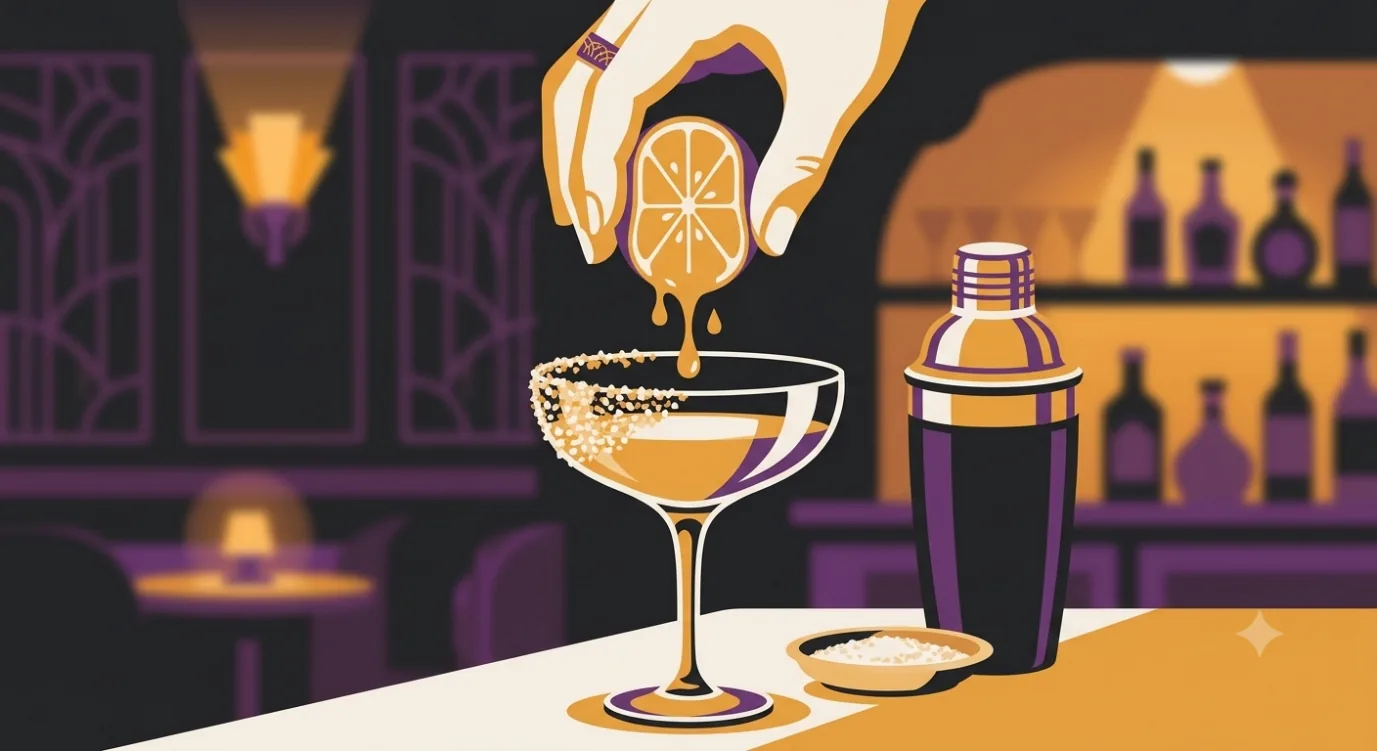
- Rub a cut lime around half the rim of a chilled glass, then roll that half in salt on a small plate. Leave the other half clean.
- Add the tequila, lime juice, orange liqueur, and agave (if using) to a shaker.
- Fill the shaker with plenty of ice and shake hard for 10–15 seconds - you want it cold and lively, with a frothy little crown.
- Strain into your prepared glass over fresh ice (or up, in a coupe, if you're feeling elegant).
- Taste, adjust with a few drops more lime or agave if needed, garnish with the lime wheel, and serve.
The reason we shake rather than stir comes down to those juices: shaking chills the drink fast and whips in tiny bubbles of air, giving a citrus sour the bright, almost effervescent texture that makes it so refreshing. Stirring is for the all-spirit drinks. Anything with fruit juice wants the shake.
One Last Pour
The Margarita has survived a century of slushie machines and dubious mixes precisely because the real thing is so simple and so good. Three honest ingredients, fresh lime, a thoughtful pinch of salt - that's the whole secret, and now it's yours.
Make one this week, salt just the half rim, and pay attention to what that first salted sip does to the drink. Then come back and tell me I was wrong. I'll be here, wiping down the counter, ready to pour another.