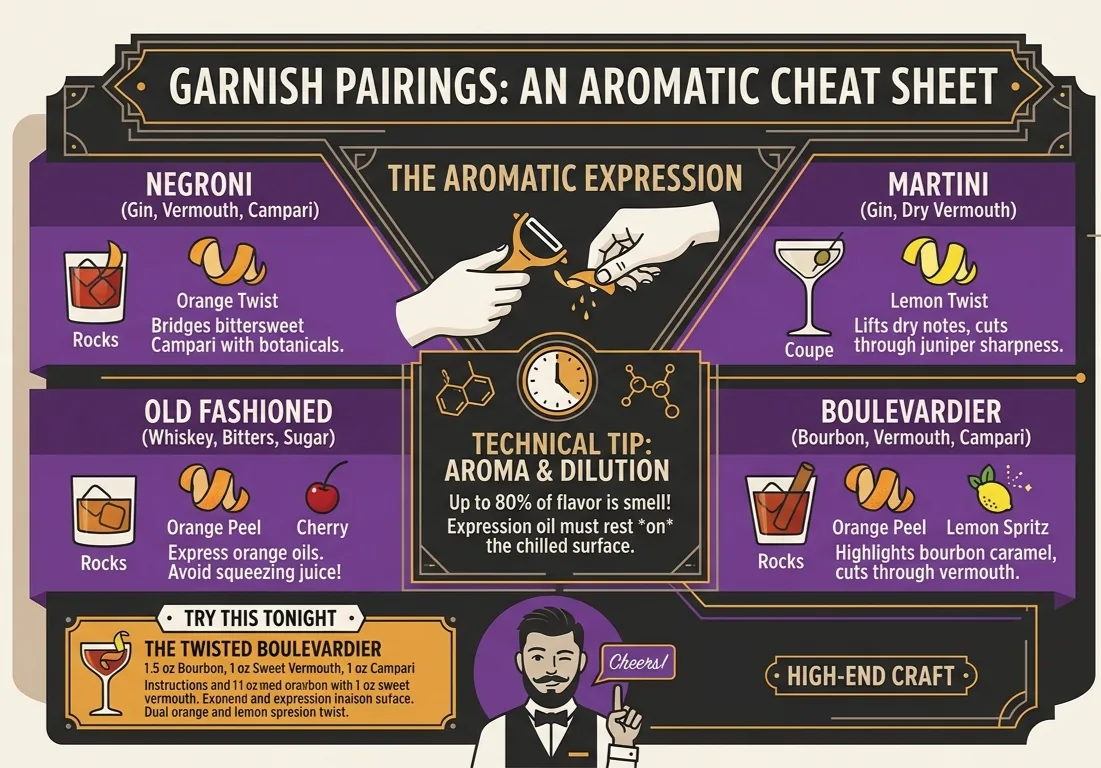
I once watched a well-meaning guest at a house party try to garnish a beautifully crafted, delicate gin Martini with a giant, sticky wedge of overripe orange that they'd aggressively squeezed into the glass. The heavy citrus oil completely flattened the subtle botanicals of the gin, turning a crisp masterpiece into a sad, oily puddle.
It was a tragedy in a coupe glass.
Too many people treat the cocktail garnish as a total afterthought - a decorative little flag you slide onto the rim just to look fancy. But a true garnish isn't a prop; it is the opening chapter of the drink. Since up to 80% of what we perceive as flavor actually comes from our sense of smell, the volatile oils resting on top of your glass dictate exactly how that first sip is going to taste.
Let's look at the science of pairing your garnishes so you can match your drinks like a pro.
The Expressed Twist: Citrus Oils as a Bridge
When you take a strip of citrus peel and snap it over a drink, you are releasing a fine mist of essential oils stored in the skin (the flavedo). These oils coat the surface of the liquid and the rim of the glass, delivering an immediate aromatic punch before the liquid even touches your tongue.
The golden rule here is matching the oil to the underlying flavor profile of your modifiers. Take the classic Negroni, for example.
Born in Florence around 1919 when Count Camillo Negroni asked his bartender to stiffen up an Americano by swapping soda water for gin, the Negroni is a perfect loop of three ingredients. The natural bitterness and rich, botanical complexity of Campari play beautifully with the deep, dark fruit and spice of sweet vermouth. To bridge these heavy elements, an orange twist is mandatory. The bright, sweet citrus aroma complements the bittersweet Campari perfectly, softening the punch without adding actual sugar.
Conversely, for a crisp, bone-dry Martini, you want a lemon twist. The sharp, high-toned acidity of lemon oil cuts through the herbal, dry vermouth and lifts the heavy juniper backbones of the gin.
The Master Class: Texture, Temperature, and Aroma
You can have the most beautiful citrus twist in the world, but if your drink lacks structural balance, the garnish will just taste like perfume on a pig. This brings us back to the ultimate technical tip of the backbar: Dilution is an active ingredient, and temperature changes everything.
When you mix your spirits, the melting ice softens the aggressive burn of the high-proof alcohol. This reduction in ABV is what allows the delicate flavor compounds - and the aromas of your garnish - to escape the surface of the liquid and hit your olfactory system.
Stirred Drinks: For spirit-forward drinks like a Negroni or an Old Fashioned, a smooth, quiet stir preserves a velvety, silky texture. Because the liquid stays dense and crystal clear, a simple expressed citrus twist sits cleanly on top, allowing you to inhale pure essential oils with every sip.
Shaken Drinks: For drinks with fresh juice or heavy modifiers, a hard shake introduces tiny air bubbles for a frothy, aerated texture. These drinks love a full wheel or wedge dropped right in, where the physical acidity can mingle with the foam.
Try This Tonight: The Twisted Boulevardier
Let's see how changing a single garnish completely reroutes a flavor profile. We are going to mix a Boulevardier - the bourbon-soaked sibling of the Negroni - and use a dual-citrus expression to highlight both the sweet and bitter sides of the drink.
Ingredients
- 1.5 oz (45ml) Bourbon Whiskey
- 1 oz (30ml) Sweet Vermouth
- 1 oz (30ml) Campari
Method
- Combine the bourbon, sweet vermouth, and Campari in a mixing glass with plenty of solid ice.
- Stir smoothly for 25 to 30 seconds until the glass is frosty and perfectly diluted.
- Strain over a large ice rock into a rocks glass.
The Garnish Technique: Cut a strip of orange peel and a strip of lemon peel. Hold them together over the glass, skin-side facing down, and express both simultaneously over the drink. Wipe the rim with the orange peel, then drop it into the glass.
The lemon oil provides a sharp, bright invitation that wakes up your nose, while the orange oil pulls out the sweet caramel notes of the bourbon and marries them to the vermouth.
Garnishing isn't interior design for your drink; it's liquid architecture. Match your aromas with intention, take your time with the peel, and I'll keep a seat open for you at the counter. Cheers.